

Last updated: December 11, 2025
In today’s hyper-competitive brand environment, where consumers are inundated by advertising and faced with a plethora of product choices, brands are struggling to stand out. To grow and be successful, it is imperative that brands drive brand differentiation in this crowded marketplace.
What is the best way to make this happen? How can you build a strong, compelling brand that is associated with key needs, benefits or desires that customers seek?
The answer lies in systematic research that reveals where your brand has permission to differentiate and which dimensions matter most to your customers.
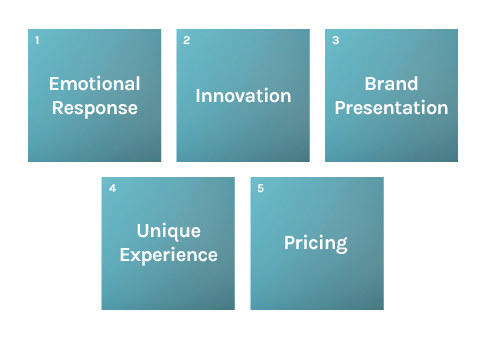
Here are five strategies to consider for driving home your brand’s points of differentiation:
Each strategy offers a distinct path to standing out, but not all will fit every brand. The key is identifying which approach aligns with your customers’ priorities and your organization’s authentic strengths. Here are five proven strategies to consider:
1. Emotional Response
This relies on providing an emotional salience that is tied to a product or service. Brands that develop an emotional connection with their customers are often better positioned than those that provide superior value alone.
Coke’s advertising often appeals to emotion in order to establish a stronger connection with consumers. Their “Share A Coke – Share a feeling” and “Hug me” campaigns illustrate just two of the ways that the company uses to evoke an emotional response. The key is understanding which emotions resonate with your specific audience and whether your brand has earned the right to claim that territory.
Measuring emotional connection requires going beyond traditional metrics. Brand love studies and emotional mapping help identify the specific feelings your brand evokes and whether those feelings translate into loyalty and advocacy.
2. Innovation
This can be expressed through physical characteristics of the products or the way in which a product or services is delivered. In short, this differentiation solves an unmet need in a unique and novel fashion.
James Dyson is an example of someone who developed an innovative product (a vacuum cleaner) thus positioning his company as a leader in innovation. With this positioning, the company has gone on to continually innovate by bringing many other novel products to market.
However, innovation as a differentiator only works when customers perceive genuine value. Jobs-to-be-Done research uncovers the underlying needs customers hire products to fulfill, revealing innovation opportunities competitors miss. Testing concepts with real customers before launch ensures your innovation solves problems people actually have.
3. Brand Presentation
How a brand presents itself to the market can be a differentiator. In this case, brands that employ a consistent character or mascot can be easily remembered and stand out in the crowd. The use of mascots can be particularly powerful when humor is used to shape brand perceptions.
A prime example is Geico’s use of an animated lizard, which has nothing to do with insurance but has come to represent, and be strongly associated with, the brand over time. Consistency matters more than cleverness. Brands that shift presentation frequently confuse customers and dilute equity.
Brand tracking studies measure whether your presentation assets (colors, characters, taglines) are building recognition over time. Without measurement, you’re guessing whether your presentation strategy works.
How can you build a strong, compelling brand that is associated with key needs, benefits or desires that customers seek?”
4. Unique Experience
This can be manifest in several ways such as a brand’s physical retail presence, exceptional customer service, ease of use of their website, the novel environment that they create, or, simply, the experience of unboxing a product.
Build-A-Bear offers children (and children at heart) the ability to custom design their own stuffed animals by selecting the color, style, size and even the amount of stuffing their animals contain. The experience the company offers is unmatched when it comes to toys.
Customer journey mapping reveals moments where experience creates competitive advantage. Immersive research techniques put brand teams directly into customer environments, seeing friction points and delight opportunities firsthand. Walking a mile in your customer’s shoes beats guessing what they want.
5. Pricing
When handled properly, this can also be an effective approach to differentiation. On one end of the spectrum, a company can strive to be positioned as the ‘low price leader’ offering customers outstanding value. On the other end, they could be positioned as a premium brand at a high price.
In some cases, an effective brand differentiation strategy can enable a brand to command a higher price premium than they otherwise could obtain.
Walmart stores are known for their low prices and good values which has allowed the company to reshape retail. On the other end of the spectrum, Starbucks has convinced consumers that there is value in paying much more for coffee than they would have before the company disrupted the purchase of coffee.
Pricing research establishes willingness to pay across customer segments. Testing price points against perceived value prevents leaving money on the table or pricing yourself out of the market. The right price strategy reinforces your chosen differentiation, whether premium or value.
How do you determine which of these strategies to deploy for brand differentiation?
Here’s the Radius 3-step approach:
Let’s dive into our 3-step approach below.
1. Define your current target customer.
Characterize the type of customers that are most likely to currently purchase your product or service and then consider targets that could be adjacent, such as customers who would consider your brand, but have not yet purchased.
Segmentation research moves beyond basic demographics to understand the attitudes and behaviors that drive choice in your category. The strongest segments balance size, accessibility, and alignment with your brand strengths.
2. Determine which characteristics are important to these groups when evaluating a purchase.
For example, should your brand evoke an emotional response, provide a superior experience, or offer a compelling price point?
Different customer segments prioritize different benefits. Qualitative research reveals the language customers use and the unstated needs driving their decisions. Quantitative studies measure which attributes actually drive purchase versus which customers say matter.
3. Assess how you are perceived vs. key competitors across these important dimensions.
Gaining perceptual insights is key to understanding the strengths and weaknesses in the market and to determining if there is white space that no brands currently occupy. Assuming that your brand has permission to occupy that space, this can be a very compelling way to differentiate your brand.
Perceptual mapping visualizes your competitive landscape. Brand tracking shows how perception shifts over time and whether your differentiation efforts are working. The goal is finding unoccupied territory where customer needs are high but no competitor owns the space.
Ready to learn more about taking a systematic assessment of driving brand differentiation?
Contact us today!